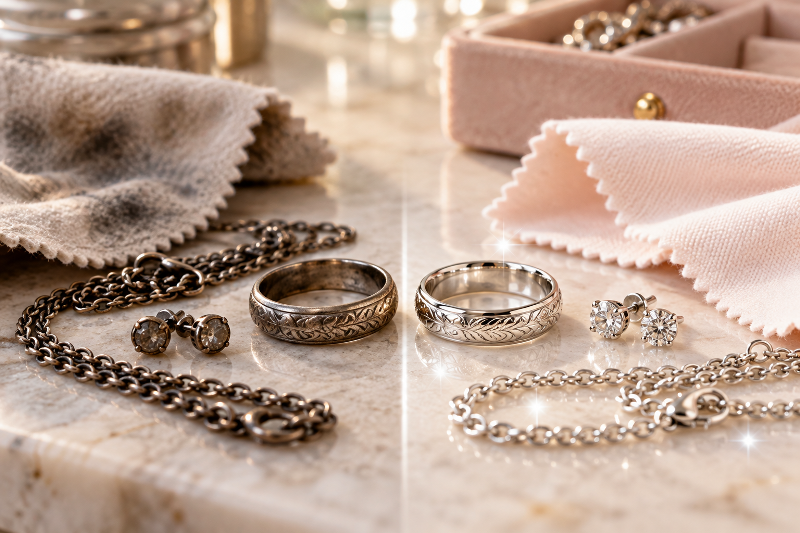
You reach for a favourite necklace or ring, only to discover that it doesn’t look quite as bright and beautiful as you remember. Perhaps the metal has darkened, lost its shine or developed patches of discolouration. So, what’s happened?
Tarnishing is a natural process that can affect certain types of jewellery over time. It doesn’t necessarily mean that your jewellery is poor quality or permanently damaged, and in many cases, its original shine can be restored.
Let’s look at why jewellery tarnishes, what you can do to help prevent it and how to bring back the sparkle when it starts looking a little lacklustre.
What causes jewellery to tarnish?
Tarnishing happens when metal reacts with substances in its environment. Oxygen, moisture and naturally occurring compounds in the air can all contribute, causing a thin layer of discolouration to develop on the surface.
Everyday life can speed up the process, too. Perfume, hairspray, cosmetics, cleaning products and even perspiration can all come into contact with your jewellery and affect its appearance.
Humidity can also play a part, which is why you might sometimes notice jewellery tarnishing more quickly during warm weather or when it’s stored somewhere damp.
The important thing to remember is that tarnishing usually affects the surface of the metal. It doesn’t automatically mean the piece itself is damaged.
Which types of jewellery can tarnish?
Some metals are more susceptible to tarnishing than others.
Sterling silver is perhaps the best-known example. It can gradually develop a darker or duller appearance as it reacts with compounds in the air. Because sterling silver contains other metals alongside pure silver, these can also contribute to the reaction.
Gold itself is highly resistant to tarnishing, but most gold jewellery isn’t made from pure 24-carat gold. Other metals are added to create different carats and give jewellery the strength required for everyday wear. Depending on its composition and the conditions it’s exposed to, gold jewellery can sometimes become dull or discoloured.
White gold can present a slightly different issue. It’s commonly coated with rhodium to give it that bright, reflective white finish. Over time, the rhodium coating can wear away, particularly on rings that are worn regularly. This isn’t tarnishing in quite the same way, but it can leave white gold looking less bright or slightly yellow in places.
At E.K. Jewellers, we offer rhodium plating to restore that crisp, bright finish to white gold jewellery.
Can you prevent jewellery from tarnishing?
You can’t always prevent tarnishing completely, but a little care can certainly slow it down.
Try putting your jewellery on after applying perfume, moisturiser, hairspray and other beauty products rather than before. It’s also sensible to remove jewellery before swimming, showering, exercising or using household cleaning products.
How you store it matters as well. Keep jewellery somewhere clean and dry, ideally in a jewellery box or individual pouch rather than leaving it exposed in a bathroom or on a dressing table. Separating pieces also helps to prevent chains becoming tangled and jewellery scratching against other items.
Giving pieces a gentle wipe with a soft cloth after wearing them can help to remove oils and other residues before you put them away.
Should you clean tarnished jewellery at home?
There are plenty of home jewellery-cleaning tips online, but this is one area where a little caution pays off.
The right cleaning method depends on the metal, gemstones, settings and overall condition of the piece. Something that’s perfectly safe for one item could potentially damage another. Certain gemstones are more delicate than others, while older or worn settings may need particular care.
It’s especially worth being cautious with jewellery that’s valuable, antique or sentimental. A treasured ring probably isn’t the ideal candidate for an experiment involving a toothbrush and whatever concoction the internet has recommended this week!
If you’re unsure, ask a jeweller before trying to clean a piece yourself.
Can badly tarnished jewellery be restored?
In many cases, yes.
Professional cleaning and polishing can remove surface tarnish, dirt and everyday build-up, helping jewellery regain its original shine. It also gives a jeweller an opportunity to look at the piece more closely and spot potential problems such as worn claws or loose stones.
Our clean and polish service can give tired-looking jewellery a new lease of life, whether it’s a favourite piece you wear regularly or something that’s been sitting unworn in your jewellery box.
And if the problem goes beyond tarnishing, don’t assume the piece is beyond saving. We carry out a wide range of jewellery repairs in-house, from repairing chains and replacing stones to more extensive restoration work.
Bring back the sparkle at E.K. Jewellers
Tarnishing and discolouration are often simply part of owning and wearing jewellery. After all, the pieces we love most are usually the ones that experience the most of everyday life with us.
Looking after your jewellery, storing it carefully and keeping it away from unnecessary exposure to chemicals and moisture can help it stay beautiful for longer. And when it needs a little professional attention, we’re here to help.
If you have a piece that’s looking dull, darkened or simply not as sparkling as it once did, bring it into E.K. Jewellers in Hainault. We’ll take a look and advise you on the best way to get it looking its best again.
