Jewellery comes with its fair share of advice. Some of it is useful, some has been passed down through generations, and some really should have been retired a long time ago.
From cleaning your rings with toothpaste to believing diamonds are impossible to damage, common jewellery myths can sometimes do more harm than good.
So, what’s true and what isn’t? We’re busting seven common jewellery myths and sharing some simple advice to help you look after your favourite pieces.
Myth 1: Diamonds are indestructible
Diamonds are famous for their hardness. In fact, they’re the hardest naturally occurring substance, which makes them extremely resistant to scratching.
But ‘hard’ doesn’t mean indestructible.
A diamond can still chip or fracture if it receives a hard knock in the wrong place. And, of course, the diamond itself is only part of a piece of jewellery. The claws or setting holding it securely can wear down, bend or become damaged over time.
That’s why even a diamond ring you’ve worn happily for years benefits from regular checks. If a stone starts moving or a claw looks worn, it’s better to have it inspected before the diamond has an opportunity to escape.
Myth 2: You can clean all jewellery the same way
If only how to clean jewellery were quite that simple!
Different metals, gemstones and finishes require different types of care. A cleaning method that’s perfectly suitable for one piece could damage another.
Pearls, for example, need much gentler treatment than many harder gemstones. Some stones are porous or sensitive to chemicals, while plated and specially finished jewellery may also require particular care.
If you’re unsure what a piece is made from or how it should be cleaned, it’s always worth asking before experimenting. For jewellery that needs a little more than careful cleaning at home, our professional clean and polish service can bring back its sparkle safely.
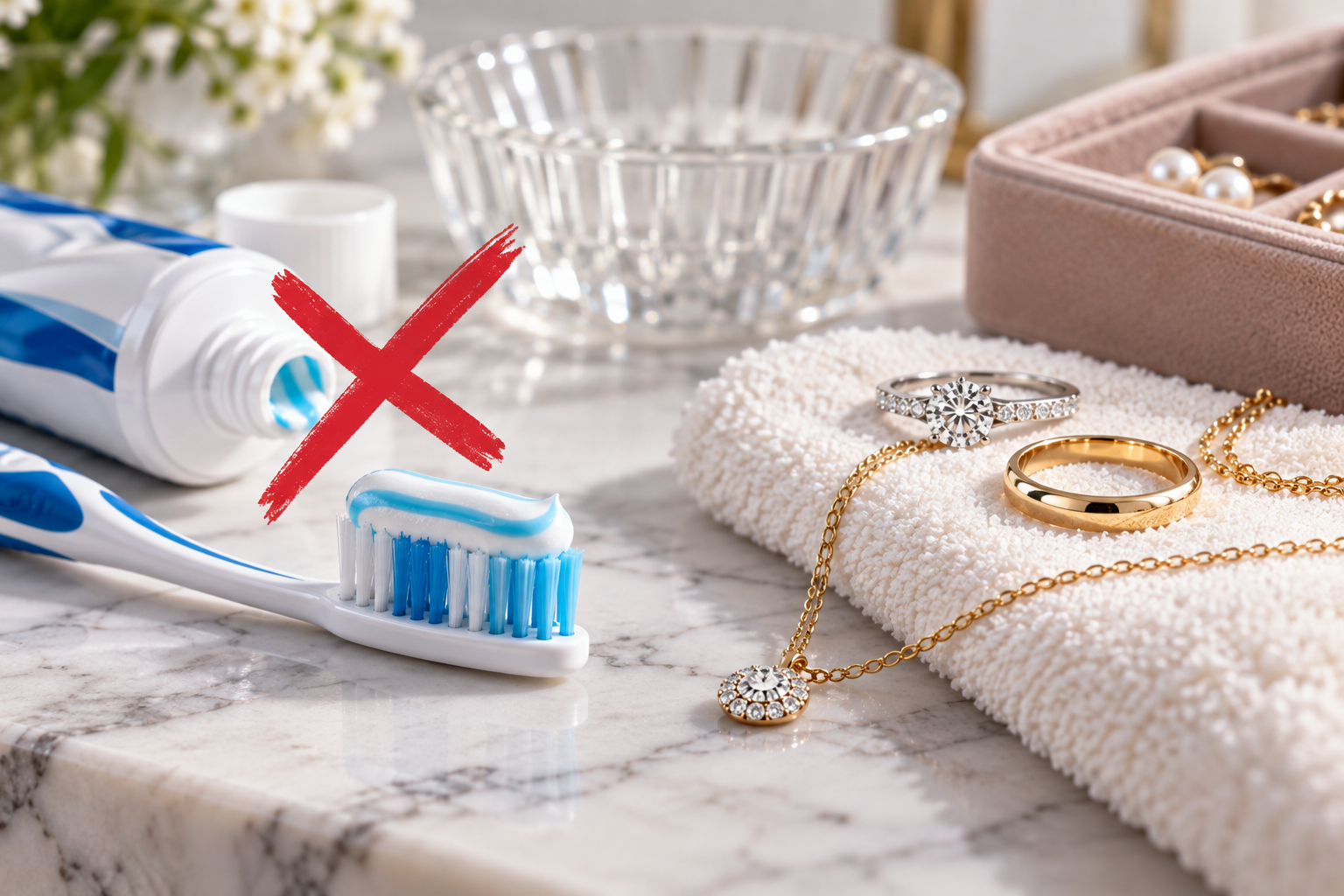
Myth 3: Toothpaste is a great jewellery cleaner
Sorry, toothpaste fans. This is one home remedy we’d leave in the bathroom.
The idea probably sounds convincing because toothpaste is designed to remove stains and deposits. The problem is that many toothpastes contain abrasive ingredients.
Those tiny abrasive particles that help clean your teeth can potentially scratch softer metals and some gemstones or damage the finish of a piece.
There are much safer ways to clean jewellery, depending on what it’s made from. If in doubt, ask your jeweller rather than reaching for the toothbrush.
Your jewellery will thank you. Your teeth can keep the toothpaste.
Myth 4: If a ring still fits, it doesn’t need checking
A ring fitting comfortably tells you that it fits comfortably. Unfortunately, it doesn’t tell you much about its condition.
Jewellery can gradually wear without any obvious change in the way it feels. Claws can become thin, stones can loosen and bands can wear down, particularly if a ring is worn every day.
You may not notice anything is wrong until a stone moves or, worse, disappears.
As we explained in our guide to regular jewellery checks, spotting these small signs early can help prevent more costly repairs later.
Myth 5: Silver turning black means it’s poor quality
Seeing a favourite silver piece become darker can be alarming, but tarnishing doesn’t automatically mean there’s anything wrong with your jewellery.
Silver naturally reacts with substances in the air and its surroundings, creating the darkened surface we know as tarnish. Humidity, cosmetics and other environmental factors can all contribute.
It doesn’t mean your silver has suddenly become poor quality, and tarnish can usually be removed with appropriate cleaning.
The important word there is appropriate. Aggressive scrubbing or unsuitable cleaning products can cause more problems than the tarnish itself.
Myth 6: You shouldn’t mix gold and silver jewellery
We’re happy to consign this one to the fashion rulebook of the past.
There’s no practical reason you can’t wear gold and silver together. In fact, mixing metals can create a stylish, individual look and make it much easier to combine pieces you already own.
The trick is to make it look intentional. Repeating both metals across a few pieces can help pull everything together, whether you’re layering necklaces, stacking bracelets or combining rings.
We explored this in more detail in our guide to choosing between gold and silver jewellery. But the short version is simple: if you like the combination, wear it.
Myth 7: Old jewellery isn’t worth repairing
This might be the biggest myth of them all.
An older piece may have considerable sentimental value, beautiful craftsmanship or simply a design you’d struggle to replace today. A broken chain, damaged setting or worn ring doesn’t necessarily mean its useful life is over.
Sometimes a straightforward repair is all that’s needed. In other cases, jewellery that no longer suits your style can be transformed into something completely different while retaining the stones, precious metal or memories that made it special.
Our jewellery repairs and remodelling service can help breathe new life into pieces you thought you might never wear again.
Good jewellery care starts with good advice
There’s no shortage of jewellery care tips out there, particularly online. The difficulty is knowing which ones to trust.
Jewellery can vary enormously, so what works brilliantly for one piece may be completely wrong for another. A little professional advice can save you from an expensive mistake and help keep your jewellery looking its best for longer.
At E.K. Jewellers in Hainault, we’re always happy to take a look at a piece, advise you on how to care for it and help if it needs cleaning or repair. Please feel free to call in, we’ll look forward to seeing you.
